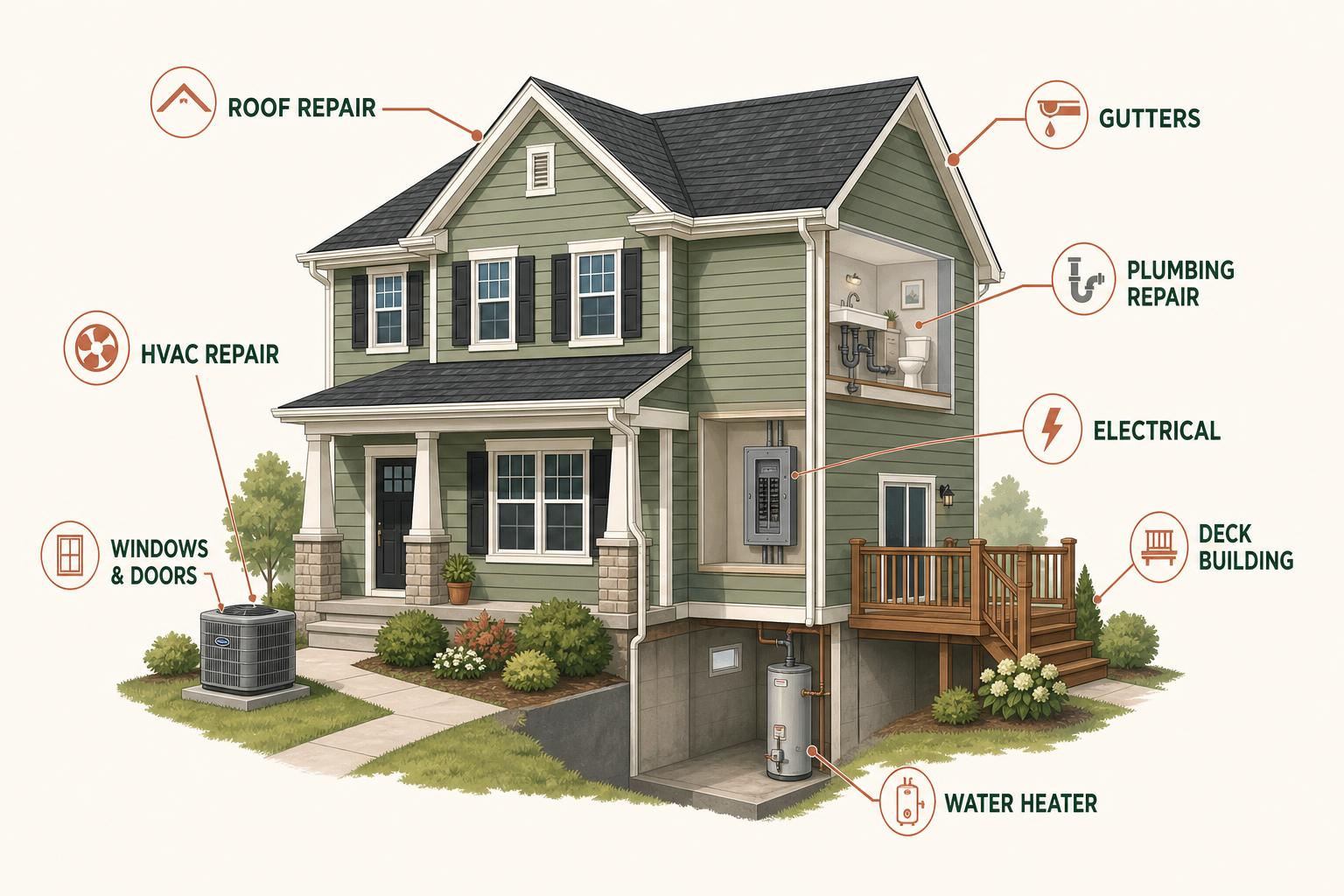
Take the next step to get a great price guarantee (or are you happy and have a home project)?
We'll help you understand costs, get options, and decide what to do next.
No pressure. Start with guidance before talking to anyone.
Remember, all estimates are free. Text or call.
Georgia Homeowner Pulse
What other Georgia homeowners are dealing with right now. Tap any card to start a quick self-check.
What happened?
Type a sentence or tap an example. No forms, no sales calls.
Real local contractors. Smaller crews. Less overhead. No pressure to hire.
No pressure — we'll simply help connect you with local options.
Take the next step to get a great price guarantee
Planning a home project in Georgia? We compare fair local pricing, flag the common budget traps, and — only if you want — connect you with vetted contractors who stand behind their quotes.
CUDAB Concierge
Describe what happened (or what you want to build). You'll get likely causes, urgency, and a real North Georgia price range — free.
Try one of these:
Estimates are AI-generated ranges for North Georgia, not quotes. All CUDAB estimates are free — call or text 404-580-0032.
What are you dealing with?
Pick the problem closest to yours. We'll show you typical pricing, what usually causes it, and whether it's a repair or a replacement.
Popular services by county
Pricing and common problems vary block-by-block across North Georgia. These are the cities homeowners ask us about most.
Gwinnett County's housing stock spans from 1960s Norcross ranches to brand-new Suwanee construction. The dominant service drivers are aging 1980s–90s HVAC systems, polybutylene plumbing failures, Federal Pacific electrical panels, and humidity-driven mold in older basements. Gwinnett is on Georgia Power and Jackson EMC depending on area — rebate programs differ.
Hall County combines Gainesville's older downtown housing with Lake Lanier's humidity-stressed crawlspaces and rural well/septic homes in the north. Mold remediation, septic service, and HVAC humidity control are the top callouts. Most areas served by Jackson EMC.
Jackson County has seen explosive new construction along the I-85 corridor while retaining significant rural well-and-septic housing inland. Service mix runs from premium-tier Braselton replacements to rural septic and well work in unincorporated areas.
What Georgia homeowners actually pay
Real ranges pulled from invoices and contractor pricing across our coverage area. Use these to sanity-check any quote you receive.
Service calls run $95–$185. Common repairs (capacitor, contactor, refrigerant top-off) land $250–$900. Full system replacement (14–17 SEER2) typically $7,200–$12,500 installed.
Standard 50-gal gas or electric tank installed $1,100–$2,200. Heat pump hybrid (with Georgia Power rebate) $2,400–$3,800 net. Tankless gas $3,500–$6,800 depending on gas line and venting work.
Inspection $250–$550. Small contained remediation (under 10 sqft) $500–$1,500. Crawlspace encapsulation with mold treatment $4,500–$12,000. Whole-house Category 3 events $8,000+.
Cosmetic refresh $4,500–$15,000. Full gut $18,000–$32,000. Primary bath with tile shower and layout change $28,000–$45,000.
Single torsion spring $175–$300 installed. Pair of torsion springs $325–$550. Extension springs $200–$400 per pair.
PEX $6,500–$14,000 for typical 2,200 sqft home. Copper $11,000–$18,000. Multi-story or slab foundations add 20–35%.
Ranges reflect typical invoiced work in Gwinnett, Hall, Jackson, Banks, Clarke, and Forsyth counties. Your home's age, access, and scope can move you up or down the range.
Did your insurer pay less than the repair actually costs?
Water damage, roof damage, mold, and fire claims in Georgia are often underpaid the first time around. We help homeowners understand the appraisal process, what a licensed Georgia public adjuster does, and when one is worth involving.
Educational guidance only — not legal, financial, or licensed insurance advice.
Built for homeowners, not lead-gen funnels.
Describe the problem in plain language. No upsell forms, no spam calls.
Cost ranges, common failure modes, and repair-vs-replace guidance specific to your county.
Vetted local pros — or just keep reading. You're never obligated to contact anyone.
See how provider profiles work.
Before you reach out, you can see who a contractor is, what they do, and what real homeowners say about them — including video walkthroughs and project updates.
Georgia Home Repair Pros
Sample profileServing Gwinnett, Hall, Jackson, Banks & Clarke County
32 homeowner reviews
- “They explained the repair options before giving a price.
- “The video walkthrough helped me understand what was wrong.
- “I felt better comparing options before hiring.
See the work, not just the ad.
Providers can post short videos, walkthroughs, project updates, and homeowner review clips through YakYak. Cudab uses those videos to help homeowners understand who they are hiring.
- →Watch a contractor explain a repair in their own words before you call.
- →See real project updates — not stock photos — to judge quality.
- →Homeowner video reviews help you spot the right fit faster.
Why smaller local crews can sometimes save homeowners money.
Many homeowners assume the biggest company is automatically the best option. In reality, many highly skilled local contractors operate with smaller crews (2–8 people), lower overhead, and less marketing expense.
- —Larger overhead (office, fleet, admin staff)
- —Bigger marketing budgets — often reflected in pricing
- —Larger crews that may be spread across multiple jobs
- —Strong brand recognition and established processes
- ✓Smaller team — often the owner works on-site
- ✓Lower overhead without sacrificing skill
- ✓Direct owner involvement and accountability
- ✓Often more competitive pricing on the same quality work
Price should never be the only factor — homeowners should compare experience, communication, reviews, and project fit. Cudab helps homeowners compare options, understand fair pricing, and learn before hiring.
Why homeowners trust Cudab.
We're not a lead broker. We're an editorial homeowner resource built on Georgia field experience, transparent pricing, and a vetted contractor network — with privacy and security taken seriously from day one.
- Licensed Georgia pros only
Every matched contractor is licensed, insured, and reference-checked.
- No sold leads
We never sell your contact info. You decide who, if anyone, reaches out.
- Editorially reviewed
Pricing and guidance reviewed by the Cudab Home Services team.
- Secure by default
Encrypted in transit, row-level security on all stored data.
- Georgia-specific
Built for North Georgia housing stock, climate, and utility rebates.
- Free, always
No paywalls, no account required to read pricing or guides.
Read before you sign anything.
A public adjuster is a state-licensed professional who represents the homeowner — not the insurance company — when documenting and negotiating a property damage claim. This page explains the role in plain English for Georgia homeowners. It is educational content, not legal or licensed insurance advice.
Water losses are the most common reason Georgia homeowners consider hiring a public adjuster. This guide walks through when it tends to make sense, when it usually does not, and how to prepare your claim either way. Education only — not legal advice.
A common pattern: the carrier issues a check that is thousands short of what the contractor needs to actually complete repairs. This guide walks through what Georgia homeowners can do next. It is educational only and not a substitute for advice from a licensed public adjuster or attorney.
Every guide we publish.
Compare local pros without the pressure.
Tell us what's going on with your home. We'll show you what fair pricing looks like in your ZIP and — only if you want — match you with vetted North Georgia contractors.